/
Why a ship seemed to float in the sky off Ajman in a video seen 31 million times
A video filmed from Ajman beach by Kerala-born photographer Jaseel Azeez shows a cargo ship apparently hanging above the sea. It drew more than 30 million views within a day. The vessel never left the water: the effect is a superior mirage.
S
4 min
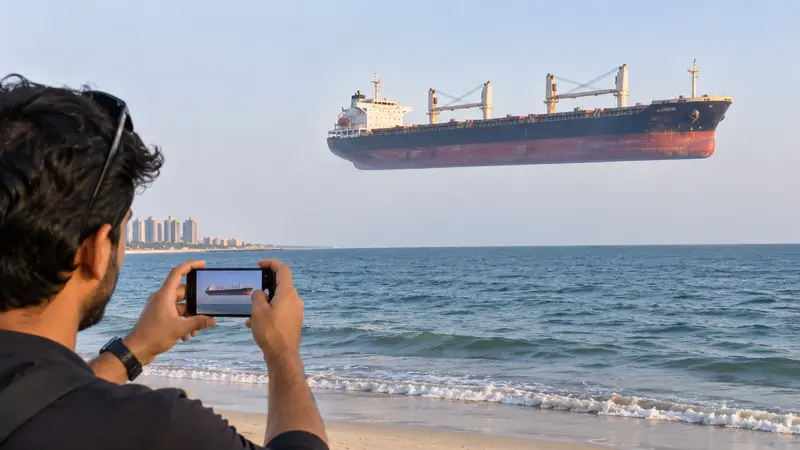
A short video of a cargo ship that seems to hover in mid-air off Ajman, in the United Arab Emirates, drew more than 30 million views within about a day. The ship was not flying. What the camera caught is a superior mirage, a trick of light that happens when layers of air at different temperatures bend the view of a distant object.
The video was shot on a phone by Jaseel Peralasseri, a Dubai-based photographer from Kozhikode in Kerala who works under the name Jaseel Azeez. He was on Ajman beach on 25 November after an assignment and has said he spent barely 15 minutes there. "The ships in the distance genuinely looked like they were floating above the water," he said. He first put the clip on his Instagram story, a friend suggested making it a reel, and the numbers climbed from there: about a million views in four hours, then tens of millions and more than a million likes. He said he never expected it.
How did people react?
Many viewers were baffled. Some thought the footage had been digitally faked, others joked about a glitch in reality, and some used it to argue about the shape of the Earth. Others said they could still make out the ship sitting on the water. No UAE authority has issued a statement on the sighting, and the vessel has not been identified.
The World Meteorological Organization describes a mirage as an optical effect made up mainly of images of distant objects, which may be steady or wavering, single or multiple, upright or upside down. Air at different temperatures has different densities, and light bends slightly as it passes from one density to another. Our eyes and cameras assume light travelled in a straight line, so the object seems to be somewhere it is not.
A superior mirage forms when the surface is much colder than the air above it, an arrangement often called a temperature inversion. Light from the ship curves downward on its way to the viewer, so the image appears higher than the object really is. A gap then seems to open between the hull and the horizon, and the closer the camera zooms, the more striking the separation can look. The effect can even bring into view things that sit below the horizon, which is known as looming, and it can persist for hours while the air stays layered.
How is it different from water on a road?
| Feature | Inferior mirage | Superior mirage |
|---|---|---|
| Surface compared with air above | Much hotter | Much colder |
| Direction light bends | Upward | Downward |
| Image appears | Below the object | Above the object |
| Common places | Hot roads, deserts, beaches | Cold seas, snowfields |
| Familiar example | Road that looks wet | Ship that seems to float |
The shimmering "puddle" on a hot highway, familiar across the Gulf and India, is the inferior kind: what looks like water is an image of the sky. The Ajman scene is the opposite arrangement.
A Fata Morgana is a very complex form of superior mirage in which images are stretched, stacked, flipped and constantly changing. It is mostly seen in polar regions. The meteorological organisation's example outside those regions is the view of mountains in Sicily across the cold waters of the Strait of Messina. The name comes from the sorceress Morgan le Fay, whose supposed castles in the air sailors described. The Ajman clip has not been identified as a Fata Morgana.
Yes. A photograph of a tanker that seemed to hang in the sky off Cornwall in England caused a stir in 2021, and the Chicago skyline has appeared across Lake Michigan from a shore where it would normally be partly hidden. Both were explained by layers of air bending light. Such sights are rare enough to surprise people, but they follow ordinary physics, and sailors have recorded them for centuries. The World Meteorological Organization, a United Nations agency, classifies mirages among the optical phenomena of the atmosphere.
Could you see one?
Possibly, if conditions line up. Look across a large body of water or a flat plain when the surface is noticeably colder than the air, often in calm weather and in the cooler months. A view near eye level helps, as does a distant object with a clear outline. A camera with a long zoom makes small displacements easier to see. Never look through binoculars or a lens towards the sun.
Before sharing an astonishing clip, ask who filmed it, where and when, and whether the original poster can be identified. A real optical effect usually has a place, a time and a physical explanation. It also helps to look for a second recording from another spot, and to remember that an astonishing picture can be perfectly genuine while the first caption attached to it is wrong. Waiting for the details costs little. The National Center of Meteorology publishes UAE weather conditions, and the World Meteorological Organization's cloud atlas explains mirages and other sky phenomena with examples.
About the Author
S
Subhash Gupta
Desk Editor
Subhash Gupta is a writer at Wirony, contributing articles that are reviewed and verified by the editorial team before publication. The publication prioritises accuracy, editorial…
S
4 min
What did you think?